How Do Cable Cars Stay On The Cable?
The mechanical answer to how cable cars stay attached, told through the Maokong Gondola's own hardware: grips, haul rope, towers, sheaves, wind and lightning rules, and what happens if it stops.
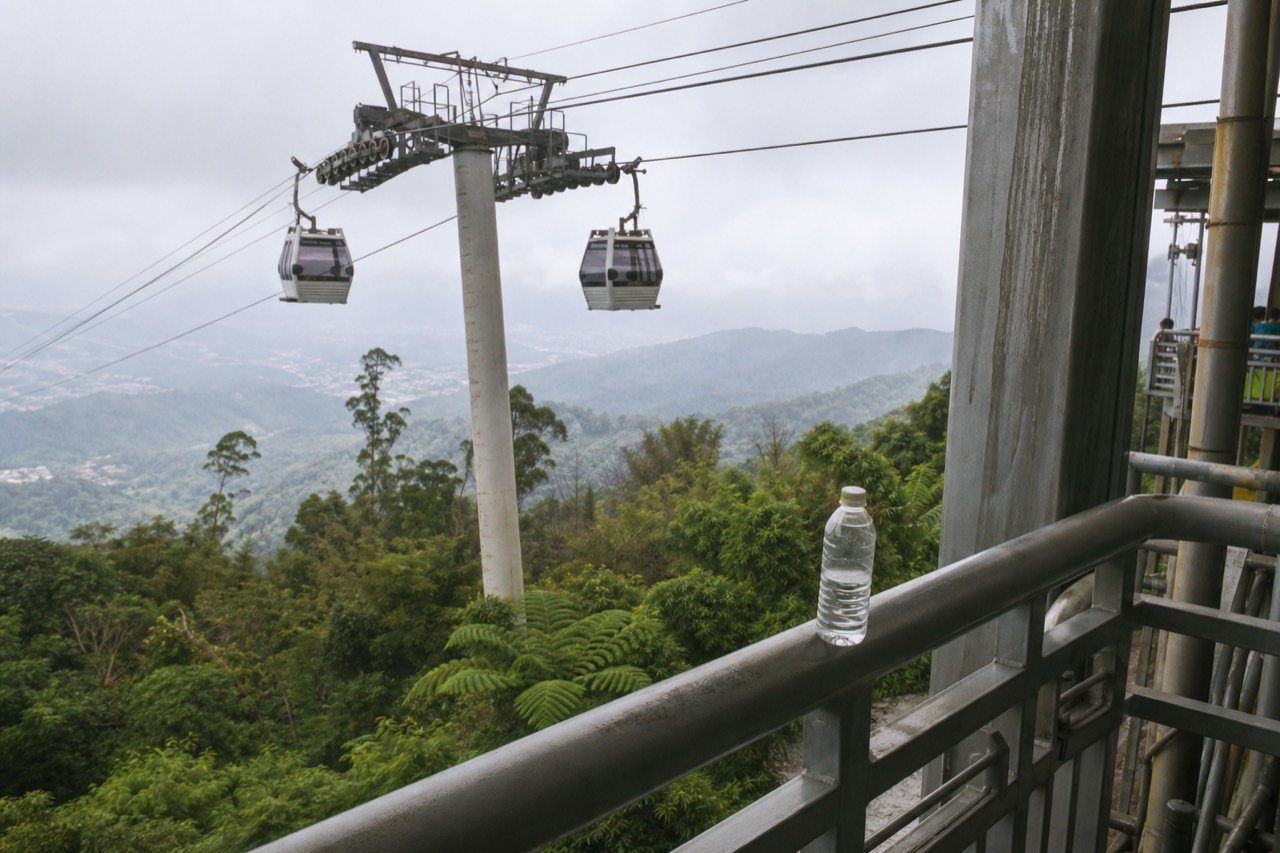
Most people assume a cable car is somehow bolted to its cable, or that the cable is threaded through the cabin. Neither is true. The cabin hangs from a small clamp called a grip, and on a detachable system like Taipei's Maokong Gondola that grip does something remarkable several hundred times a day: it opens, lets go of the rope, and grabs it again, all without a human touching it. The system is a monocable automatic-circulating gondola built by POMA of France, and the operator, Taipei Rapid Transit Corporation, describes the cabins as moving through the stations the way plates move along the conveyor belt in a Sushi Express shop. The whole line runs anti-clockwise, continuously, with no timetable and no departures board, because the rope itself is the timetable.
How Do Cable Cars Stay On The Cable?
A cable car stays on the cable because a spring-loaded grip on the cabin clamps onto the haul rope with enough force to carry the full weight of the cabin and its passengers, and on detachable systems that grip only releases inside a station, where a rail-guided track holds the cabin safely while it slows down. The Maokong Gondola works exactly this way: cabins have no motors at all, and the grip does all the holding.
The detail worth understanding is the word "detachable". Older fixed-grip chairlifts drag the cabin along at full rope speed at every station, which is why you have to hop on and off quickly. A detachable gondola is different. As a cabin enters a station, its grip opens mechanically, disengages from the haul rope, and the cabin coasts onto rubber tyres in the station track that slow it to walking pace. Passengers get on and off. At the far end of the station the tyres accelerate the cabin back up to rope speed, the grip closes onto the rope again, and the cabin is carried out over the valley.
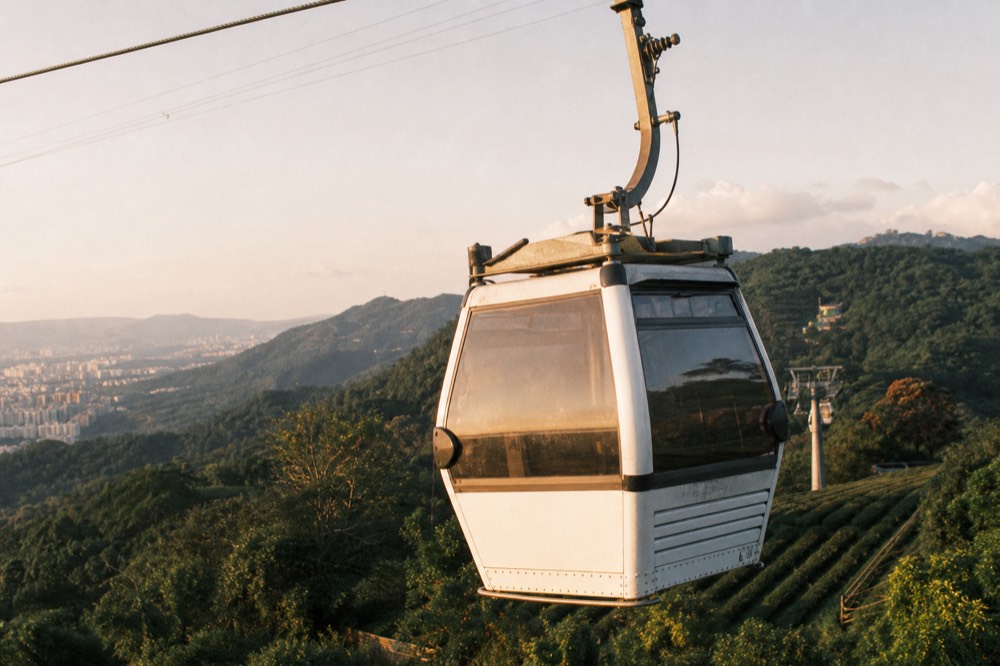
The grip is not trusted blindly, either. As every cabin passes through a station on this line, grip-force sensors test that its clamp is holding the rope with the correct pressure, a check that happens on every single circuit, every day. If a grip is not squeezing hard enough, the system knows before the cabin leaves the building. Cable-dislocation detectors on the maintenance platforms and towers watch the other side of the problem, confirming the rope is still sitting correctly in its tracks everywhere along the 4.033 km route.
The route itself is unusual, and it matters for how the system holds together. The line is roughly shaped like the numeral 7, in the operator's own description, with six stations: four passenger stations and two angle stations closed to the public. POMA described the result as five successive gondola sections, unique in the world, because each station introduces another rope-to-rope transition. The bends in the "7" do not happen where most visitors guess. The physical order is Taipei Zoo, Angle Station 1, Taipei Zoo South, Angle Station 2, Zhinan Temple, then Maokong, so the direction change comes before Zhinan Temple Station, not at it, and the main drive machinery sits on an elevated platform above the platform level of Angle Station 2.
If reading about the mechanics makes you want to see it from inside a cabin, the practical starting point is a ticket, and there are a few ways to buy one.
What Is The Haul Rope Actually Made Of?
The haul rope is a continuously moving steel cable, woven from high-tensile strands around a core, that carries every cabin on the line at once. On the Maokong Gondola it runs in one endless anti-clockwise loop, driven by a main motor at Angle Station 2, and each cabin's grip clamps onto it and rides it like a clothes peg on a washing line. The rope never stops moving while the system is running.
The rope is the single most stressed component on any gondola, which is why it gets its own maintenance calendar. In April 2026 this line shut down completely from 20 to 24 April for cable-splicing works, a five-day closure published in advance in the operator's 2026 suspension calendar, in which sections of the rope are re-trimmed and re-joined. The big annual overhaul ran 8 to 28 June 2026 and replaced major drive components including the main motor, drive-sheave bearings, drive-sheave liners, the drive shaft and the rescue motor, followed by non-destructive testing, de-rusting, repainting and load tests before the line reopened on 29 June.
Steel rope does not last forever, and when this line's haul rope was eventually retired from service, it was not scrapped. It was recycled into the "LOVE" installation that stands on the welcome wall at Maokong Station today, a sculpture built from the gondola's own decommissioned steel cable, which the operator says symbolises the idea that true love grows better with age. Passengers who ride to the top walk straight past a piece of the machinery that carried them. Alongside it, since early January 2026, the station also has a new open-air observation deck called Sky Green, with a view across the whole Greater Taipei basin by day and night.
One rope-related question the site's Maokong Gondola pages get asked constantly is whether the cabin can slip off when the wind blows. The honest answer is that the grip is the last thing that fails, because the system stops running long before conditions reach anything like that point. The published thresholds are specific, and they are the real safety mechanism.
When Does The Gondola Stop For Wind, Lightning Or Earthquakes?
The Maokong Gondola suspends service when gusts reach 16 metres per second, about Beaufort force 7, and hold for more than three seconds, or when any gust exceeds 18 m/s; when lightning strikes anywhere along the route; at earthquake intensity 4 or above; and when a typhoon land warning covers Taipei. After lightning, the system restarts only once 30 clear minutes have passed with no further strikes in the warning zone, then only after inspection.
The wind rule is the one that quietly shapes most visitors' plans, because Taipei's typhoon season runs from May to November with activity peaking in August and September. A gust that holds for four seconds at force 7 is enough to halt the whole line, and the operator applies the rule without discretion. The restart after lightning is deliberately vague in the operator's own wording: because thunderstorm duration cannot be predicted, the operator explicitly refuses to forecast a restart time, and instead publishes the 30-minute rule as the earliest possible window, followed by an inspection.
Earthquakes get a graduated response rather than a simple on-off switch. At intensity 4 or above, service suspends and passengers are evacuated. Below that threshold, the system checks all tower and system monitors, then runs at a reduced speed of 1 m/s for 5 minutes, and returns to normal speed if nothing abnormal appears. For context, the line's normal operating speed is 3 to 5 m/s, with a maximum design speed of 6 m/s, so the post-earthquake crawl is a fraction of usual pace.
| Trigger | Published threshold | What happens |
|---|---|---|
| Wind gusts | 16 m/s held over 3 seconds, or any gust above 18 m/s | Service suspends immediately |
| Lightning | Any strike along the operating route | Halt at once; restart no earlier than 30 clear minutes plus inspection |
| Earthquake | Intensity 4 or above | Suspension and passenger evacuation |
| Earthquake below 4 | System checks pass | Reduced speed of 1 m/s for 5 minutes, then normal if clear |
| Typhoon | Land warning covering Taipei | Suspension, judged against actual wind and rain |
Typhoon closures are not theoretical on this line. Typhoon Bavi shut the gondola on 10 and 11 July 2026 before it reopened on 12 July, and on 13 August 2026 the system stopped from 14:00 for Taipei's civil-defence air-raid drill. There is a planning upside worth knowing: post-typhoon days often deliver the clearest visibility and bluest skies of the whole season, and the weather and closures guide covers how to read the forecasts around them.
Given how weather-dependent a visit can be, it helps to lock in a ticket that keeps your options open.
What Do The Towers And Sheave Assemblies Do?
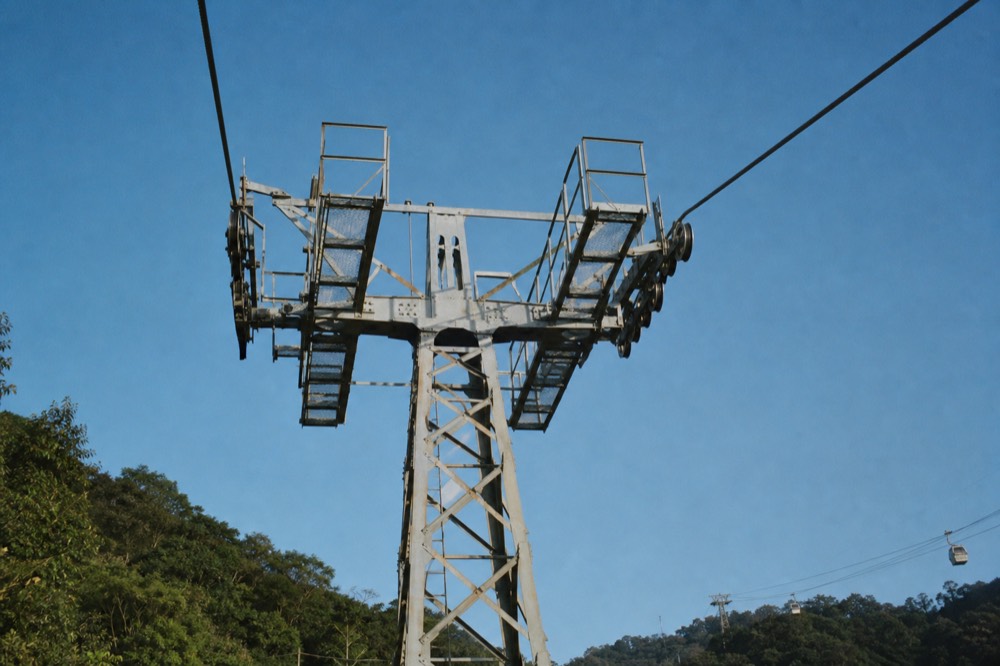
The route's 25 pier foundations carry 47 tower columns, and on top of each tower sits a sheave assembly, a bank of grooved wheels that supports the haul rope and holds it in its correct line, keeping the cable under steady tension and alignment between stations. The sheaves are the reason the rope does not sag into a catenary dip under the weight of 147 cabins, and every tower is monitored for movement in three dimensions.
The fleet number matters for understanding the load: 147 cabins in total, including 3 spares, of which 31 are Crystal Cabins with reinforced glass floors. Regular cabins carry up to 8 passengers, crystal cabins only 5, because the glass floor panel alone weighs over 200 kg. With cabins distributed along the whole 4.033 km loop, the towers and their sheaves share the working load continuously, and the drive system at Angle Station 2 pulls the entire train of hanging cabins as one.
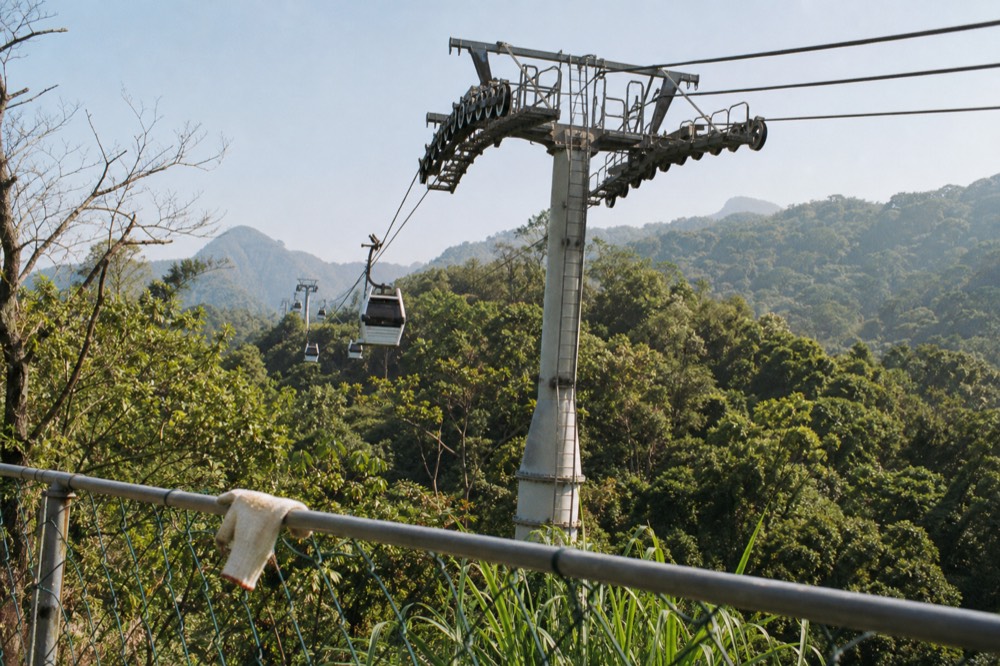
The tower monitoring is the direct legacy of the line's hardest chapter. In September 2008, heavy rain from Typhoon Jangmi caused a landslide on the slope near Tower 16, and Taipei City Government suspended the line on 1 October 2008 for assessment; the closure ultimately ran to 30 March 2010, roughly 18 months, and Tower 16 was relocated. Today every tower base is watched by underground borehole inclinometers checking for ground movement, ground-level tilt plates take regular readings, and superstructure monitors watch the tower tops for any incline or dislodgement. The hillside, not just the hardware, is under permanent observation.
The safety systems stack in layers behind the sheaves and grips. Lightning rods sit on every station and tower, backed by a Taiwan-wide omni-directional lightning detection network that gives advance warning of approaching storms. Emergency stop buttons sit on the passenger and maintenance platforms, and grip-force sensors test every cabin's clamp on every pass through a station, as described above.
What Happens To Passengers If It Stops Mid-Ride?
If the system halts while cabins are in the air, passengers already aboard are set down at the nearest safe station and the line is cleared. Passengers left at the upper stations are taken back down the mountain by free shuttle buses, a published operator commitment that almost nobody mentions in advance. Nobody is expected to walk down, and nobody is left to arrange their own transport off the mountain.
That shuttle-bus commitment is the single most practical fact in the operator's rules, and it deserves wider attention. Lightning in Taipei can appear on an otherwise sunny afternoon, and a family that rode up for tea at the top can find the cabins stopped and the last descent cancelled. The published answer is not a refund and a long walk: free buses move stranded passengers down from the upper stations, and the Maokong Tour Bus Right Line and Left Line are free to gondola passengers on the same day anyway, part of the city's stitching of the zoo, the gondola and Maokong into one integrated park.
If a cabin genuinely cannot be brought in, there is a rescue ladder behind that. Diesel-generator-driven emergency backup motors can pull cabins into stations at 1 m/s, and a crown-gear rescue system does the same job if the main gearbox fails. Power comes from a twin-circuit supply that switches over automatically if the mains fail. The final tier is human: Taipei City Fire Department's vertical rescue team, three people, two line rescuers and a tower assistant, can abseil from a tower directly into a cabin. In practice this tier is almost never needed, because the backup motors exist precisely so that it is not.
For ticket holders, the published compensation rule covers the one-day pass: if service suspends and a passenger has ridden once, the difference is refunded, with one single-journey fare deducted; a passenger who has ridden twice or more gets no refund. No equivalent published rule exists for an unused single-journey ticket, so the day pass is the better hedge on a weather-risky day. The tickets and prices guide breaks down the full fare structure, including the flat NT$180 single journey and NT$300 day pass at the gate.
If you would rather have the pass sorted before you travel, the operator's live listing is the direct route.
Is The Maokong Cable Car Actually Safe?
By the manufacturer's own written assessment, yes: POMA's president wrote in October 2007 that Maokong had reached the best availability rate recorded on any gondola lift at that time, and in April 2012 POMA confirmed an average availability of 99.90% across 2010 and 2011, calling it the best availability rate recorded to date on any cable car system, a figure the manufacturer put in writing for a line that had just spent 18 months shut.
That last clause is the reason the figure is meaningful rather than promotional. After the 2008 Tower 16 landslide and the long closure that followed, the rebuilt line was scrutinised from every angle, and it then ran at 99.90% availability over two full years, as measured by the company that built it and would carry the reputational cost if the number were false. Cumulative ridership passed 40 million in May 2026, announced by the operator, which is a lot of clamp-and-release cycles on the grips described at the top of this article.
The published interruptions in 2025 and 2026 were routine weather suspensions and scheduled maintenance. The 2026 closure calendar is published to the day, including the five-day April cable-splicing shutdown and the three-week June overhaul, and it is worth checking before any trip because the exact maintenance Mondays vary month to month. The operator's English summary of the Monday rule does not perfectly match its own dated calendar, so the calendar wins.
The honest summary of the mechanics is this: a cable car stays on the cable because a tested clamp holds a monitored rope that is supported by watched towers. The entire system is also designed to stop, gently and often, long before any of those components is asked to do anything heroic. The stopping is not a failure of the design. It is the design.
Before the practical questions, one planning note: the crystal cabin guide covers the glass-floor option, which is an on-site NT$50 per person per trip upgrade on top of whatever ticket you hold, and is not included in any advance ticket option.
The short answers below cover the grip mechanism, the wind and lightning thresholds, the earthquake procedure, what happens to passengers when the line stops, and the line's safety record, all drawn from the operator's published rules and the manufacturer's own written figures. Each one can be read on its own, and each traces back to an official source.
Common Questions About How Cable Cars Stay On The Cable
How Do Cable Cars Stay On The Cable?
A spring-loaded grip on each cabin clamps onto the continuously moving haul rope. On detachable systems like the Maokong Gondola, the grip opens inside each station so the cabin can slow to walking pace for boarding, then re-clamps onto the rope as the cabin accelerates out. Grip-force sensors test the clamp on every pass through a station.
Does The Cable Car Cabin Have A Motor Or A Driver?
No. Cabins on this line have no motors and no drivers. The haul rope is driven by a main motor at Angle Station 2, and the cabins are passive, carried by their grips like pegs on a line. The operator compares the circulation to the conveyor belt in a Sushi Express shop.
What Stops The Cable Car In Strong Wind?
Service suspends when gusts reach 16 m/s, about force 7, and hold for more than three seconds, or when any gust exceeds 18 m/s. The rule is published by the operator and applied without discretion, which is why windy afternoons sometimes close the line while the sky still looks clear.
What Happens If Lightning Hits While I Am Up The Mountain?
Cabins in the air are set down at the nearest safe station, and passengers left at the upper stations are taken down the mountain by free shuttle buses. The system restarts only after 30 minutes with no further lightning in the warning zone, plus an inspection.
Can An Earthquake Knock A Cabin Off The Cable?
At intensity 4 or above the service suspends and passengers are evacuated. Below that, the system checks its monitors and runs at 1 m/s for 5 minutes before returning to normal speed. The grip, the sheaves and the tower monitoring are all designed with this in mind.
Has The Maokong Gondola Ever Had A Serious Accident?
The line's worst episode was the September 2008 Tower 16 landslide after Typhoon Jangmi, which led to an 18-month closure and the tower's relocation. After reopening, manufacturer POMA confirmed in writing an average availability of 99.90% across 2010 and 2011, and cumulative ridership passed 40 million in May 2026.