What Is The Longest Cable Car In The World?
The world records for cable car length are three different records with three different holders. Where the Maokong Gondola's 4.033 km route honestly sits, and the metric on which it actually leads its peer set.
What Is The Longest Cable Car In The World?
There is no single record holder, because "longest" splits into three different records with three different holders. For total route length, the Teleférico de Mérida in Venezuela is generally credited as the longest passenger cableway. For the longest single uninterrupted span, the Wings of Tatev aerial tramway in Armenia is the usual record holder. For sheer vertical rise, the mountain cableways of Venezuela and China dominate. The Maokong Gondola, at 4.033 km, holds none of these records.
That last sentence matters, because plenty of local enthusiasm online would like to claim a record for Taipei's hillside cableway. The verified figure from the operator, Taipei Rapid Transit Corporation, is a route length of 4.033 km, rounded to 4.03 km on the English pages. That is a genuinely long urban ropeway, and it is one of the longer cableways in Asia that runs inside a city's public transport network. But it is not the longest cable car in the world, in any of the three senses that phrase can take, and pretending otherwise would be dishonest reporting.
The reason the question has no clean answer is that the industry itself splits the records. A "cable car" or ropeway can be measured end to end, span by span, or from bottom station to top station in pure climb. A system with many intermediate towers can cover a huge total distance while never holding a long single span. A system with one enormous span can be shorter overall than a rival that hops across a whole mountain range. Confusing the three is how most of the contradictory lists online are born.
The Mérida system in the Venezuelan Andes is the usual answer to the total-length question, a multi-section ropeway built to reach Pico Espejo high above the city. The Wings of Tatev in Armenia holds the single-span record, crossing a gorge in one unbroken stretch of cable. And the biggest vertical-rise systems are the high-mountain ropeways of South America and China, where the top station sits far above the base. Each of those is a different engineering problem, solved a different way.
If you want to ride a Taipei system yourself, the five options below cover the one-day pass and its variants.
What Does "Longest" Actually Mean, And Who Holds Each Record?
There are three separate length records in the ropeway world, and they have three separate holders. Total route length favours multi-section systems strung across whole mountainsides, and the Venezuelan Andes hold it. Longest single span favours one huge unbroken cable, and Armenia's Tatev tramway holds that one. Largest vertical rise belongs to the high-altitude mountain ropeways, where top stations sit far above their bases. No system holds more than one of the three.
Total route length is the number most people mean when they ask the question. It is the distance a cabin travels from one terminus to the other, towers and intermediate stations included. Multi-section ropeways can stack a lot of distance this way, because the engineering limit is not the cable but the number of stations you are willing to build. The Mérida line in Venezuela is the standard citation here, and its top station is also among the highest passenger ropeway stations on Earth, which is a separate distinction again.
The longest single span is a different beast entirely. Here the record is about one continuous stretch of haul rope between two support points, with no towers in between. The Wings of Tatev aerial tramway in Armenia is the system usually credited with this one, crossing the Vorotan gorge in southern Armenia. Tramways like this use a bicable design, with a static track rope the cabin rolls along and a separate haul rope pulling it, precisely because a single span that long cannot be an ordinary circulating gondola.
Vertical rise is the third record, and it is the one mountaineers care about. The high Andean and Himalayan-adjacent ropeways climb enormous heights from base to summit station, and the Mérida system is again among the leaders. None of these figures make a system "better" in any sense a visitor feels. They are just different engineering answers to different terrain.
| Record | What it measures | Generally credited holder | Why it wins |
|---|---|---|---|
| Longest total route | End-to-end distance, all sections | Teleférico de Mérida, Venezuela | Multi-section ropeway strung across the Andes to a very high summit station |
| Longest single span | One unbroken stretch of cable | Wings of Tatev, Armenia | Crosses the Vorotan gorge in southern Armenia |
| Largest vertical rise | Height difference, base to top station | High-mountain ropeways (Andes, China) | Top stations sit far above their bases |
| Most sections on one ticket | Successive gondola sections a passenger rides | Maokong Gondola, Taipei | Five back-to-back sections, called unique in the world by its manufacturer |
That last row is where Taipei's line enters the conversation, and it enters it honestly, on a record that actually belongs to it.
How Long Is The Maokong Cable Car, Really?
The Maokong Gondola's verified route length is 4.033 km, published by the operator, Taipei Rapid Transit Corporation, and rounded to 4.03 km on the English pages. That places it among the longer urban passenger ropeways in Asia, but nowhere near the world total-length record. Its real distinction is structural: six stations produce five successive gondola sections on a single ticket, which its French manufacturer, POMA, described as unique in the world.
The route runs from Taipei Zoo Station up through Taipei Zoo South Station and Zhinan Temple Station to Maokong Station, with two additional angle stations closed to the public. The operator describes the shape of the line as roughly like the numeral 7, and the bends happen at those two angle stations, one before Zoo South and one before Zhinan Temple. The direction change is emphatically not at Zhinan Temple itself, a detail almost every visitor gets wrong, because the angle stations are invisible to passengers and never appear on the route map.
POMA of France, the system manufacturer, went on record about the design. Its own description calls it "five successive sections… unique in the world", because six stations on one continuously circulating monocable line produce five back-to-back gondola sections, all covered by one ticket. The system is a detachable monocable, cabins with no motor of their own, each clamped to a continuously moving haul rope by a grip that releases inside stations. Taipei Rapid Transit's own analogy is that it works like the conveyor belt in a sushi restaurant.
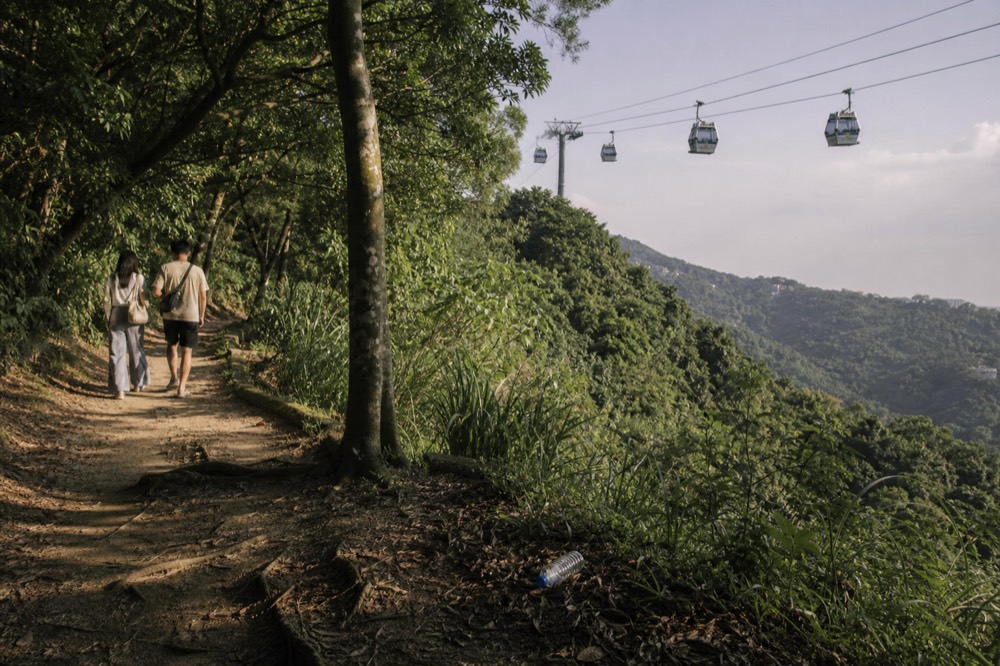
The engineering scale is respectable without being record-breaking. Twenty-five pier foundations carry 47 tower columns along the 4.033 km. Maximum design speed is 6 m/s, with actual operating speed between 3 and 5 m/s, which gives a ride time of roughly 20 to 30 minutes end to end, stretching toward 37 minutes when the system runs slow. The line climbs roughly 250 metres over that distance, a figure that would not register on a vertical-rise leaderboard, but which is exactly what a tea-growing hillside above a city requires.
Why Does Maokong Hold None Of The Length Records?
Maokong holds no length record because it was never built to chase one. It is an urban transit ropeway serving a 4.033 km corridor between a metro terminus and a tea district, not a mountain expedition system, and its design choices, short sections, an intermediate station at the zoo, and a bent 7-shaped route, all trade total distance for passenger convenience. What it has instead is a structural claim and a price claim no longer system can match.
The comparison that Taipei City Government itself published is the honest way to place this line among its peers. When the fare structure changed on 3 March 2025, the city released a per-kilometre cost table to justify the new prices, and that table is the metric on which Maokong genuinely leads its set. At roughly NT$45 per kilometre after the increase, it came in well under every comparable tourist cableway the city benchmarked.
| Cableway | Published cost per kilometre | Source of figure |
|---|---|---|
| Singapore Mount Faber line | ~NT$230/km | Taipei City benchmark table, 2025 |
| Songdo Cable Car, Korea | ~NT$210/km | Taipei City benchmark table, 2025 |
| Sun Moon Lake Ropeway, Taiwan | ~NT$100/km | Taipei City benchmark table, 2025 |
| Hakone Ropeway, Japan | ~NT$80/km | Taipei City benchmark table, 2025 |
| Maokong Gondola | ~NT$45/km | Taipei City benchmark table, 2025 |
That is roughly a fifth of Singapore's rate and under half of Japan's Hakone figure, per kilometre of cable. A single-journey regular cabin fare is a flat NT$180 regardless of distance, and the one-day pass is NT$300 for unlimited rides on the day of activation. The flat fare itself is a post-March-2025 change: the old structure charged NT$70, NT$100 or NT$120 depending on how many stations you rode, and that scale was abolished on 3 March 2025. Almost every older guide still online quotes the dead fares.
The structural claim is the other thing Maokong holds. POMA's written assessment of the system, kept on the operator's own history pages, is that the five-section arrangement reached the best availability rate recorded on a gondola lift at the time, and that the design was unique in the world. For a system that had already survived an 18-month closure after Typhoon Jangmi triggered a landslide near Tower 16 in 2008, that manufacturer endorsement is the more meaningful trophy than raw length.
Which Record Would Maokong Actually Contend For?
The record Maokong can genuinely contend for is the most successive gondola sections on one continuously circulating line, five sections across six stations, a configuration its own manufacturer called unique in the world. It also sits near the top of the urban ropeway class for route length inside a city transport network, and its per-kilometre price is the lowest in Taipei's own published benchmark set. None of that involves total length, single span, or vertical rise.
The distinction between a circulating gondola and a tramway matters here. The record-holding systems for total length and single span are mostly tramways: two large cabins shuttling back and forth on a track rope, departing on a schedule. Maokong is the opposite model, a monocable automatic-circulating gondola with 147 cabins including 3 spares, of which 31 are glass-floor Crystal Cabins, moving continuously with no timetable at all. Cabins pass every few minutes; you walk up and board, like stepping onto a moving walkway.
That design is why Maokong's capacity figure is high for its length, a maximum one-way throughput of 2,400 passengers per hour, and why the line has carried more than 40 million cumulative passengers since opening on 4 July 2007, a milestone announced by the operator in May 2026. A shuttle tramway of record-breaking span could never move those numbers, because two cabins cannot. Different records, different machines.
For a visitor deciding what to ride, the practical translation is simple. You are not riding a world length record, and you should discount any guide that says you are. You are riding a five-section circulating system that its manufacturer considered structurally unique, for about NT$45 per kilometre, the cheapest rate in its peer set. The one-day pass, from about $9.49 with about 11,700 reviews behind it, is the product that matches that pitch, and it is genuinely hop on, hop off across all four passenger stations.
The same pass also unlocks a free transfer that most visitors never use: since 3 March 2025, every gondola rider can ride the Maokong Right Line and Left Line tour buses for free on the same day, tapping the same EasyCard. That turns the 4.033 km of cable into the spine of a much larger loop over the tea hillside, which is a better use of the day than chasing a record the line does not hold.
How Do The World's Record Systems Compare With A City Line Like Maokong?
The world's record-holding ropeways and a city line like Maokong are barely the same species of machine. Record systems are destination attractions: long shuttles, huge spans, extreme altitudes, high fares and low frequency. Maokong is transit: short headways, a metro-station terminus, EasyCard payment, flat fares and a maintenance calendar published to the day. The right comparison for Taipei's line is other urban ropeways, and in that class it is long, cheap and structurally unusual.
Consider what the record systems ask of a passenger. The longest-span tramways run a handful of departures an hour between two fixed points, charge premium attraction fares, and shut down entirely in weather because there is no intermediate station to set anyone down at. Maokong's weather rules are granular by comparison: service suspends when gusts reach 16 m/s and hold for more than three seconds, or exceed 18 m/s, or when lightning strikes anywhere along the route, and if the line halts with passengers at the upper stations, free shuttle buses take them back down the mountain. That is a transit operator's playbook, not an attraction's.
The maintenance regime is transit-grade too. The 2026 calendar published by the operator lists every routine Monday closure to the day, plus a five-day cable-splicing shutdown from 20 to 24 April and the annual overhaul from 8 to 28 June, with resumption on 29 June. The overhaul replaced major POMA components including the main motor, drive-sheave bearings and drive shaft. A record-chasing tourist ropeway rarely publishes that level of detail, because its passengers do not commute past it.
And the passenger experience reflects the difference. On Maokong you can board at a metro terminus, ride up, walk the Camphor Tree Trail, drink tea, and ride down on the same NT$300 day pass, with children aged 0 to 5 riding free alongside a ticketed adult, up to two per adult. On a record-holding mountain tramway, you ride the span, photograph the view, and ride back. Both are good days out. Only one of them is a piece of a city.
Is The Maokong Cable Car Still Worth Riding If It Holds No Record?
Yes, and the reason is that records were never the point of this line. The Maokong Gondola is a 4.033 km working transit system with five successive sections its manufacturer called unique in the world, the lowest per-kilometre fare in its published peer set, a glass-floor cabin option for an extra NT$50 per trip, and a free same-day transfer to the Maokong tour buses. Length is the least interesting thing about it.
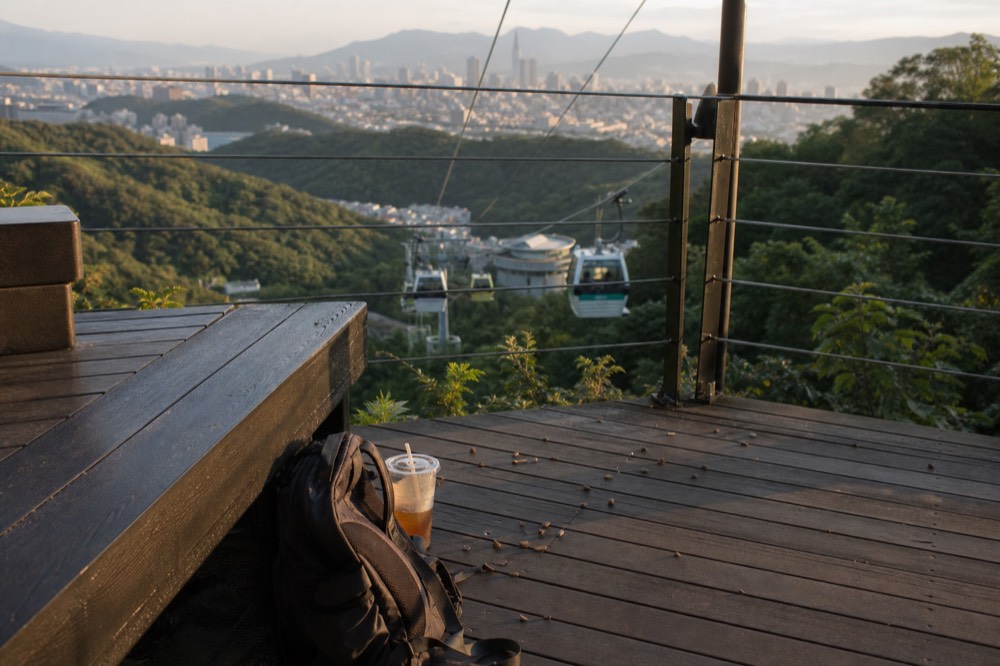
The view is the argument most visitors actually make. The line climbs roughly 250 metres from Taipei Zoo Station to Maokong Station, crossing forested ridge after ridge with the Taipei basin spreading below, and the Crystal Cabin puts a reinforced glass floor, three layers about 48 mm thick and roughly 213 kg of it, between your feet and the valley. The upgrade is an on-site surcharge of NT$50 per person per trip on top of whatever ticket you hold, and it is not included in any advance ticket option.
The destination is the other argument. Maokong Station now has a new observation deck, Sky Green, which opened in early January 2026 and gives an open view over the whole Greater Taipei basin, day and night, plus a LOVE installation built from the gondola's own retired haul rope. From the station, the tea district of the hillside begins immediately, and the story behind it is better than any record: Muzha is the only place in Taiwan where Tieguanyin is cultivated, from twelve seedlings tea master Chang Nai-miao carried from Fujian in 1895.
For planning the practical side, the hours and maintenance calendar matters more than any length statistic, because the Monday closures vary month to month and the annual overhaul takes the line out for three weeks each June. The route and station guide explains the 7-shaped line and the two invisible angle stations in detail, and the glass-floor upgrade, with its long weekend queue, is covered in the crystal cabin guide.
The broader picture of what this hillside offers is in what Maokong is famous for, from the twice-yearly tea harvests to the pothole geology that gave the place a name that has nothing to do with cats, despite what the characters suggest. The Maokong Gondola is the thread that ties all of it together, and that is a better claim than a length record it does not hold.
The questions below are the ones visitors most often ask when they first hear that the Maokong Gondola is not a world record holder. The short answers cover the three separate length records, where Taipei's 4.033 km line honestly sits, and what this system can genuinely claim instead: five successive sections its manufacturer called unique in the world, and the lowest per-kilometre fare in its published peer set.
Common Questions About Cable Car Records And Maokong
What Is The Longest Cable Car In The World?
There is no single holder, because there are three separate records. For total route length, the Teleférico de Mérida in Venezuela is generally credited as the longest passenger cableway. For the longest single span, the Wings of Tatev tramway in Armenia holds the record. For vertical rise, the high-mountain ropeways of the Andes and China lead. The Maokong Gondola, at 4.033 km, holds none of the three.
How Long Is The Maokong Gondola?
The verified route length is 4.033 km, published by the operator and rounded to 4.03 km on the English pages. The ride from Taipei Zoo Station to Maokong Station takes roughly 20 to 30 minutes at normal operating speed, up to about 37 minutes when the system runs slow.
Does The Maokong Gondola Hold Any World Record?
It holds a structural distinction rather than a length record: six stations produce five successive gondola sections on one ticket, a configuration its manufacturer, POMA of France, described as unique in the world. It also has the lowest published per-kilometre fare in Taipei City's own benchmark set, roughly NT$45 per kilometre.
Why Do Different Websites Give Different Answers For The Longest Cable Car?
Because they are measuring different things. Total route length, longest single span and largest vertical rise are three different records with three different holders, and lists that mix them produce contradictions. A multi-section ropeway can have a huge total length with no long span, and a single-span tramway can hold the span record while being shorter overall.
Is The Maokong Gondola The Longest Cable Car In Asia?
No. Several mountain ropeways in China and other parts of Asia exceed its 4.033 km route length. Within the class of urban ropeways integrated into a city transit network, however, Maokong is among the longer ones, and it is unusual for its five-section configuration and its metro-terminus location.